


Published in the ANFF ACT & WA Node Newsletter
Issue 47 - March 2021
pH-dependent surface charge probed by atomic force microscopy through surfactant adsorption
Group III-nitrides are a group of important semiconductor materials for many electronic and optoelectronic applications, including (but not limited to) water-splitting and portable chemical sensing applications based on (GaN/)AlGaN/GaN structures. Studying the surface charge properties of gallium nitride (GaN) and aluminium gallium nitride (AlGaN) in contact with electrolytes is essential for their influences in such applications.
Researchers at The University of Western Australia, in collaboration with the University of California, Santa Barbara, have studied the surface charge and hydrophobicity properties of GaN and AlGaN surfaces as a function of pH using atomic force microscopy (AFM) in liquid medium. AFM soft-contact images and force curves were used to probe the pH-dependent adsorption of the cationic surfactant cetyltrimethylammonium bromide (CTAB) and anionic surfactant sodium dodecylsulfate (SDS) on GaN surfaces. Additionally, GaN/AlGaN/GaN heterostructure-based ion sensing devices were used to measure the surfactant adsorption over the same pH range.
The AFM force curves suggest that the GaN and AlGaN surfaces are positively charged at low pH and negatively charged at high pH, with a similar isoelectric point of ~ pH 5.5. The structure of the adsorbed surfactant aggregates, revealed by soft-contact images, suggests that the main surface charging mechanism of the GaN and AlGaN surfaces is the protonation and deprotonation of surface hydroxyl groups, similar to silica (though with a different isoelectric point). The findings of this research project provide useful insights into the design of AlGaN/GaN-based chemical sensors, especially in terms of surface layer structure selection and surface manipulation.
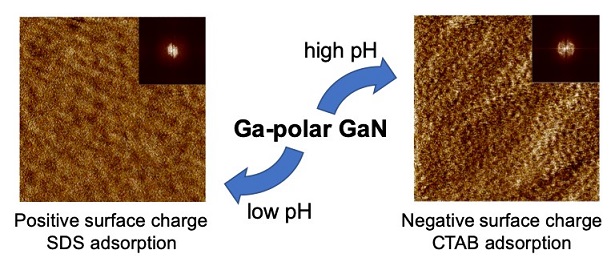
Figure 1 Soft-contact AFM images of surfactant aggregates adsorbed on a GaN surface at different pH: at low pH, the GaN surface carries a positive charge, attracting anionic SDS aggregates, while at high pH, the GaN surface carries a negative charge, attracting cationic CTAB aggregates.
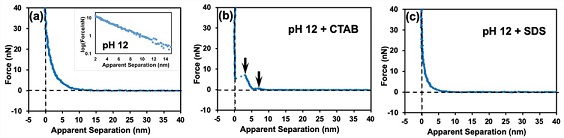
Figure 2 AFM approach curves of silica tip-AlGaN surface force vs. separation under various conditions as labelled. Inset of Figure 2(a) shows the log-linear scale of Figure 2(a). Black arrows indicate push throughs, a force curve feature corresponding to AFM tip rupturing adsorbed surfactant aggregates.
For further details, articles “pH-dependent surface properties of the gallium nitride – Solution interface mapped by surfactant adsorption” and “pH-Dependent surface charge at the interfaces between aluminum gallium nitride (AlGaN) and aqueous solution revealed by surfactant adsorption” are published in the Journal of Colloid and Interface Sciences and are available at https://doi.org/10.1016/j.jcis.2019.08.079 and https://doi.org/10.1016/j.jcis.2020.09.036.
Article written byJianan Wang, UWA